
 Khmer
Khmer
By: MANG Valy, AN Raksmey, SREY Sambunnarong
Supported By: UNESCO Participant Programme
The ancient Cambodian tradition, marking the commencement of the agricultural season, customarily features a ceremony known as the “Royal Ploughing Ceremony” (or Chrot Preah Nengkol). This ritual is widely recognized as a national event, historically staged on the Meru field adjacent to the Royal Palace in Phnom Penh, and observed in various provinces (see Chap Pin 1960).
However, a distinctive, localized version of the Chrot Preah Nengkol ceremony persists in at least two villages within the Sambor Prei Kuk temple complex: Sambor village and Chamnar Chas village. Of special note, this local iteration diverges significantly from the national ceremony as it excludes the actual plough or oxen traditionally used to till the soil (see Huon Savong 2022). The purpose of this specific village ritual is to invoke blessings and good fortune from the local guardian spirit (Neak Ta Chas Srok). It is performed to inaugurate the farming season, petition for abundant rainfall, ensure general well-being, and protect the community (including homes, people, and animals) from lightning strikes.
Furthermore, the location of this specific ritual is strictly confined to the area immediately in front of the Neak Ta (local guardian spirit) shrine, mirroring the setting described for the Leung Neak Ta ceremony previously mentioned. The selection of the Neak Ta shrine as the venue is necessitated by the spirit’s functional role and direct association with agricultural matters, as the Neak Ta is considered the nexus of productivity and the guarantor of stable agricultural yields.
The spiritual power concentrated at the Neak Ta cannot naturally diffuse on its own; human intervention is required to activate it. Consequently, the local people perform the ritual at this site, signifying that while the Neak Ta ensures the overall prosperity of the harvest, humans are responsible for drawing out this power. This process of drawing out the energy involves a specific ritual designed to enable the Neak Ta’s power to permeate the villagers’ rice fields, thereby securing a complete and abundant rice harvest.
Regarding the timing of the Chrot Preah Nengkol ceremony in these two villages, it is typically scheduled during the waxing moon phase of the month of Vesak (a period preceding the National Royal Ploughing Ceremony). Specifically, and similar to the Leung Neak Ta ritual, the Chrot Preah Nengkol is preferentially held on a Tuesday or a Saturday. This selection is rooted in the belief that Tuesday is a “hard day” (thngai roeng), allowing non-human entities (spirits) to move freely, while Saturday afternoon is considered the optimal time for these non-human entities to fully receive the offerings presented by humans.
Although both Sambor and Chamnar Chas villages are situated near the Sambor Prei Kuk temple complex and conduct the Chrot Preah Nengkol ritual with identical underlying concepts and objectives, the specific procedures and execution of the ceremony differ between the two communities. The following section will provide a detailed breakdown of the ritual activities in each village.
- Sambor Village
The Chrot Preah Nengkol ceremony in Sambor village traditionally takes place at the beginning of the month of Visakha. Although it is preferentially held on a Tuesday or a Saturday, in some years the ceremony is observed on different days. For example, in the year 2025, the ritual was performed on a Monday, corresponding to the 9th day of the waxing moon. This timing coincided with the onset of the rainy season, by which time some rice fields had already been sown and were displaying lush, green growth.
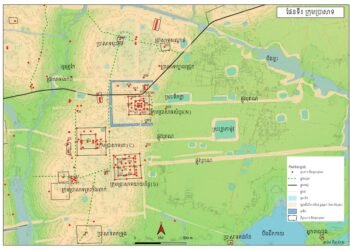
The primary activities of the ceremony are conducted at the Neak Ta Tvear (Gate Guardian Spirit) shrine, situated in the center of the village, and subsequently extend to the rice fields located south of the shrine. Furthermore, a specialized ritual called “polishing the stone” (dos rum-oel thmor) is performed in front of the Neak Ta Prei Thom (Great Forest Guardian Spirit) shrine, also known as Lok Ta Prei Kuk, which is located at the eastern entrance to the Sambor Prei Kuk temple complex.
This specific ritual does not commence at the medium’s house, unlike the Leung Neak Ta ceremony. Instead, participants gather directly at the Neak Ta (spirit) shrine at approximately 2:00 PM. Furthermore, the Chrot Preah Nengkol ceremony here excludes the use of a spirit medium (roup snong), a musical ensemble, or ritual possession dancing.
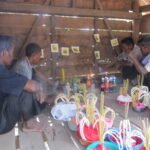
A notable observation is the demographic of the attendees, who are predominantly middle-aged women and children, with a relatively low participation rate among middle-aged men. Universally, attendees representing each family bring a mandatory offering called Bay Srov (rice offering) or, alternatively, Proleung Srov (the soul of the rice). This practice echoes the tradition observed in the Leung Neak Ta ceremonies of the Kuoy ethnic group in Veal Veang, Koun Kaek, and Andas villages. However, the Bay Srov offering here is not identical to that seen in the Kuoy rituals. Of special note, the offering is presented in a cloth-wrapped bowl (pdil) containing a neali cake, with thin bamboo strips affixed with popped rice (liech srov), known as Kuor Srov (rice sheaf) or Phka Srov (rice flower), inserted atop the cake (Figure 1).
The Kuor Srov (rice sheaf) is intentionally made soft and curved, symbolizing a rice plant that bears full, healthy grains, thereby representing the community’s aspiration for a bountiful future harvest. In this context, the neali cake serves as a symbolic representation of the rice field—the source of agricultural production—while the curved popped rice affixed above it symbolizes the rice plant bowing under the weight of ripened kernels.
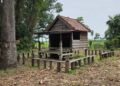
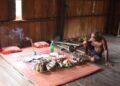
This conceptual framework bears a striking resemblance to the symbolism of the Shiva Linga and Yoni base in Hinduism, sharing a singular underlying concept despite being interpreted through distinct belief systems (one animistic, the other Hindu). All the assembled Bay Srov, Phka Srov, or Proloeng Srov offerings are subsequently arranged together inside the Neak Ta Tvear shrine. The explicit purpose of this arrangement is to enable the rice seeds to absorb the power and authority of the Neak Ta (guardian spirit), or alternatively, to have the spirit’s energy transferred to the seed rice. This process is intended to fully empower the seeds, ensuring an abundant yield for the forthcoming planting season (Figure 2).
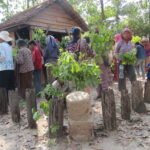
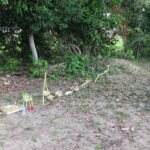
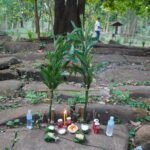
In addition to the Bay Srov offering, the villagers collect branches from a wild tree species identified as Sandaek Prei (Wild Bean), which they symbolically designate as the “Prosperity Tree” or Deum Preah Phum (Figure 3). A pair of these Sandaek Prei or Deum Preah Phum branches must be used and are typically inserted into the ground surrounding the Neak Ta Tvear shrine, a ritual act referred to as “planting the Prosperity Tree” (kampong dam deum preah phum) (Figure 4).
This raises the question of why the Sandaek Prei is not designated as a rice plant but rather as the Deum Preah Phum, and what connection exists between the Neak Ta (spirit) and the Prosperity Tree. To address this, an understanding of Preah Phum is necessary. Preah Phum signifies the supporting earth and the non-human entity (spirit) of the land, which is strictly defined by specific boundaries. The Sandaek Prei or Deum Preah Phum appears to function as a marker defining the boundary between the village (srok) and the forest (prey), or perhaps as a means of symbolically consolidating the village area, given that the branches are planted in a perimeter around the Neak Ta Tvear shrine (Mao Sithybunnawadh 2015: 119).
As is generally understood, the area around the Neak Ta shrine clearly delineates the boundary between the village and the forest. Specifically, the shrine itself and the area directly in front of it mark the village boundary, while the site for offering sacrifices (such as chickens, goats, and pigs) to the south-east of the shrine marks the forest boundary, which is the dwelling place of the lower-tier non-human entities (beast-spirits, amanus tirrechhan). Consequently, the Sandaek Prei is named Deum Preah Phum (Prosperity Tree) as a symbolic marker used to define the frontier between the village and the wild.
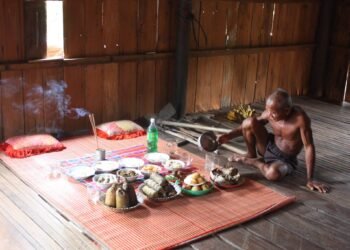
In addition to the two principal offerings described above, a separate set of offerings intended for the forest spirits (khmaoch prei) is arranged in the southeast quadrant of the Neak Ta Tvear shrine, similar to the arrangements in the Leung Neak Ta ceremony. This offering area features a pair of skewered chickens as the primary sacrifice, along with various items crafted from banana sheath, including shackles, an ox-cart, a horse, an elephant, a goat, a pig, and a pavilion (sala). These items are loaded with numerous edible human provisions (Figure 5).
The sequence of the Chrot Preah Nengkol ritual in Sambor village can be segmented into five distinct and important phases: (1). The Offering Ritual (Kech Saen Pren), (2). The Transmission Ritual (Kech Banhchuon), (3). Planting the Prosperity Tree in the Field (Kech Doat Deum Preah Phum knong Srae), (4). Polishing the Stone Ritual (Kech Dus Rum-oel Thmor), (5). Affixing the Prosperity Tree and Rice Offering in the House (Kech Doat Deum Preah Phum Chorng Pha’oab Chea-muoy Bay Srov knong Chrum Sasar Kanloang Phteah).


1.1. The Offering Ritual (Kech Saen Pren)
This phase commences once a sufficient number of villagers have gathered at the ceremony location. The ritual is overseen and led by four elderly men, who are traditionally referred to as the Chao Meung, similar to the practice in the Leung Neak Ta ceremony. A key difference, however, is that during the Chrot Preah Nengkol, the Neak Ta shrine is filled with the numerous Bay Srov (rice offerings) brought by the villagers.
The procedure for the offering ritual is otherwise consistent, involving specific individuals responsible for pouring rice wine and water, alongside various other offerings. Nevertheless, the offerings presented to the Neak Ta during the Chrot Preah Nengkol are less elaborate than those in the Leung Neak Ta ceremony, which include more substantial items like monkey meat and turtle stir-fried noodles. For the ploughing ritual, only a small quantity of standard foods, desserts, and snacks is offered.
Following the preparation of the offerings and the lighting of incense and candles, the four Chao Meung (ritual leaders) enter the Lok Ta Tvear (Gate Guardian) shrine. Two of the Chao Meung then simultaneously pour rice wine and water onto the offerings and the spirit stone (thmor Neak Ta), accompanied by an invocation and supplication:
“We respectfully invite the Old Spirit of the Territory (Lok Ta Chas Srok Bon-tuk Phum), the spirits who protect all the forests, especially the Gate Guardian Spirit (Lok Ta Tvear) in the center of the village, and the 121 Great Forest Guardians (Lok Ta Prei Thom). We also invite all spirits residing in places that the children and grandchildren cannot fully enumerate. This is the cool season, the month of Visakha, the Royal Ploughing Ceremony. Oh, esteemed spirits, please come to this place to receive the offerings that your children and grandchildren have presented. We supplicate that you grant prosperity and good fortune to your children and grandchildren. May they find peace and avoid suffering. Furthermore, we ask that you send down abundant rain (preah pirun) so that your children and grandchildren may plant their rice and crops, allowing them to flourish, grow, and yield in abundance. We invite you to partake in the offerings…!”
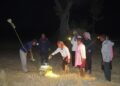
Following the initial invocation, the participants observe a brief pause of approximately one minute. They then proceed to repeat the entire process of pouring the rice wine and water, and delivering the full invocation (as detailed above), ensuring this sequence is completed a total of three times (Figure 6).
1.2. Kech Banh Chuon (The Sending-Off Ritual)
Shortly following the completion of the offering ritual, the Kech Banh Chuon (Sending-Off Ritual) commences. Its primary objective, similar to the Lok Ta Thvear enthronement ceremony, is the expulsion of malicious spirits and savage ghosts from the village and its vicinity. Notably, this specific sending-off ritual is not accompanied by an Arak musical ensemble; instead, it is conducted and managed exclusively by a single village elder, the Chao Mueng.
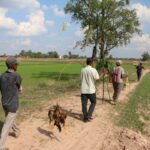
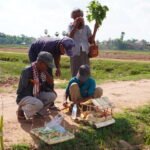
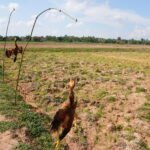
The ritual objects utilized for the sending-off are fashioned from banana sheaths and midribs, taking the forms of various conveyances and structures, including ox carts, buffalo, horses, elephants, cheung trom (an offering platform), square rafts, and communal halls (sala). These objects are laden with offerings of cooked rice and food for the procession, which is led by a pair of sacrificed chickens (Figure 7). The procession proceeds south of the Lok Ta Thvear shrine, and the items are ultimately deposited at a four-way intersecting rice field dike (Figure 8–9).
The choice to parade the items and dispose of them to the south is likely based on the conceptual framework that the “rice field” (ti srae) represents the forest or borderland, the territory situated outside village boundaries were non-human, savage entities dwell. Conversely, the Lok Ta Thvear shrine location is understood as the “village” (ti sruk), the human domain. Moreover, the selection of the four-way intersecting dike as the disposal site is probably intended to disorient these savage ghosts and evil spirits, preventing them from returning to their point of origin (Ang Choulean 2012–2013: 32–36).
1.3. Planting the Phum Deity Stems in the Rice Fields
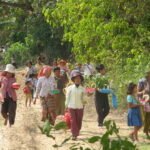
Concurrently with the procession of the sending-off items, all participants collected the rice, paddy, and the Phum Deity Stems (Deum Preah Phum) that had been previously positioned at the Neak Ta shrine and staked on the surrounding offering platforms. They carried these collected items, forming a secondary parade behind the main procession (Figure 10).
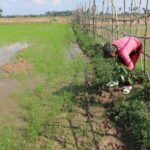
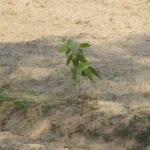
During this movement, individuals whose rice fields were situated nearby were required to uproot one wild bean plant or one Phum Deity Stem (from the paired set). They would then take this item and plant (or stake) it specifically at the entrance point where water flows into their respective rice fields (Figures 11–12).
The action of planting these stems is intended as a request for the Phum Deity Stem—which is charged with energy received from the Neak Ta spirit—to disseminate this energy throughout the field. This transference of spiritual power aims to guarantee the healthy growth of the rice plants and secure a bountiful harvest. This practice is rooted in the belief that the water entering the field will be purified by the Neak Ta’s energy, which then flows in to nourish the rice crop.
1.4. Anointing the Stone (Dos Rum’oel Thmor)
The ritual proceedings were not yet fully concluded. Significantly, all villagers, regardless of age, were required to remain gathered in the rice field located south of the village to await the arrival of the anointed stone (rum’oel thmor). This stone paste was transported from the shrine of the Neak Ta Prei Thom (also known as Neak Ta Prei Kuk), situated at the eastern entrance of the Sambor Prei Kuk temple complex. While the main ceremony took place at the Lok Ta Thvear shrine in the village center, a concurrent ritual, the “Stone Anointing Ritual” (Kech Dos Rum’oel Thmor), was being conducted at the Neak Ta Prei Thom in Sambor Prei Kuk.
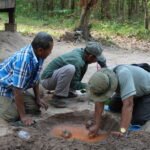
Before this concurrent ritual began, offerings similar to those presented at the Lok Ta Thvear shrine were prepared at the Neak Ta Prei Thom‘s shrine (Figure 13). The actual rubbing to extract the stone anointing paste (rum’oel thmor) was performed by a group of men directly in front of an ancient staircase within the Sambor Prei Kuk temple complex (specifically the North Group), immediately adjacent to the Neak Ta shrine. The origin of this specific rubbing practice is unknown, though it is speculated to be centuries old, evidenced by the large depressions worn into numerous staircase stones at the 7th-century C.E. Sambor Prei Kuk temple.
The process of extraction involves several key steps:
(1). Locating the Stone: Soil is dug up to find the specific temple staircase stone used in previous years, as it is traditionally re-buried with soil after the ritual’s completion.
(2). Moistening: Water is poured onto the slab to moisten it and facilitate the rubbing process.
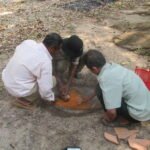
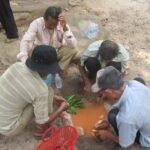
(3). Rubbing: Bricks from the temple ruins found near the shrine are used to rub against the staircase stone, generating the orange-colored “stone anointing paste” (rum’oel thmor) or “stone sediment” (kom’ael thmor), which matches the brick color (Figure 14).
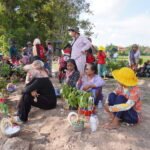
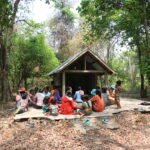
A strict, long-standing prohibition (tranam) is imposed during the rubbing: all individuals involved are forbidden from speaking to any outsider, communicating only amongst themselves. Once sufficient paste is produced, the group gathers leaves from a specific type of vine growing around the Neak Ta shrine to wrap and package the paste. This vine is colloquially known as “Leaf of Gathering” (Sleuk Chum) or simply “A Chum” (Figures 15–16). While the Chao Mueng’s group was busy extracting the paste, the villagers who had initially gathered at the Lok Ta Thvear shrine left the structure and assembled beneath the shade of a thlok tree near the rice fields. They waited here for the group transporting the anointed stone from the Neak Ta Prei Thom (Figure 17).
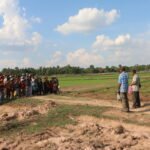
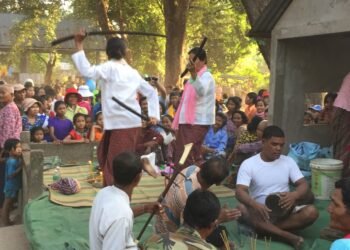
As soon as the paste-carrying group emerged from Sambor Prei Kuk, proceeded across the rice fields, and drew near, the waiting villagers immediately stood up and walked toward them. At this point, one man, acting as the village representative, initiated a ceremonial dialogue, which unfolded as follows (Figure 18):
Representative: “Where have you come from? What is your purpose?”
Stone Group: “We have come from the city of perfect characteristics, Nokor Varaṇasī Srei Krup Leak, bringing gold and silver to enter the village of Sambor.”
Representative: “Since you possess such vast wealth, could it be that you are thieves who have stolen this property before entering my village? We fear that your intentions are not good. Do you have clear evidence?”
Stone Group: “No, that is not true! We come with good intentions. We truly bring gold and silver to request entry into your village and to bring prosperity and well-being to your community.”
Representative: “What are your names, then?”
Stone Group: “Our names are Ta Sok (Grandfather Happiness) and Yiey Chea (Grandmother Prosperity)!”
Representative: “Ta Sok and Yiey Chea bring gold the size of a krak root, and silver the size of a tamarind root. They have been traveling since yesterday and have only arrived today, and they are not thieves. Ta Sok and Yiey Chea bring this so that the children of the village and the countryside may have comfort and happiness, and even when rain, thunder, and lightning shake the earth, they shall remain safe, and no one from the village will suffer sickness. If your arrival is legitimate, we request one leaf-packet of your gold.”
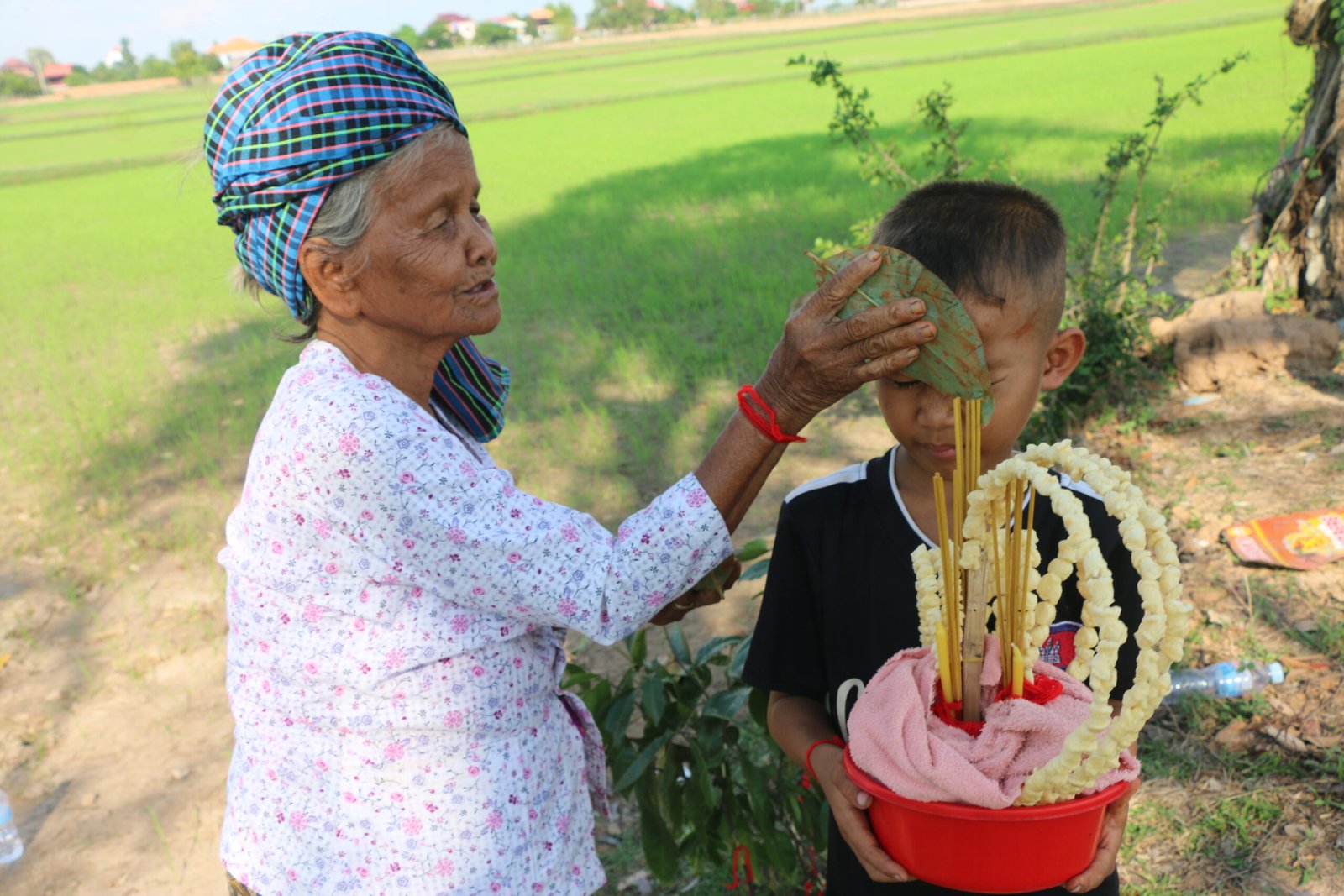
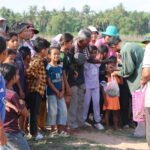
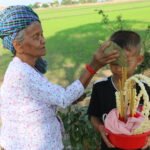
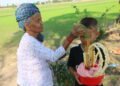
Following the ceremonial request for a packet of the “gold,” the Stone Group immediately approached the waiting villagers, holding the Sleuk Chum leaf-packets containing the anointing paste. The villagers responded by shouting a three-fold cheer, affirming the truthful and benevolent nature of the Stone Group’s responses. Instantly, the children rushed towards the Stone Group to eagerly scramble for the vine leaves containing the stone paste, which originated from the Lok Ta Prei Kuk shrine. The children smeared the paste directly onto their foreheads (Figures 19–20). Some participants also carried the paste home to anoint the foreheads of other children who were unable to attend the ceremony.
The primary purpose of anointing the children’s foreheads with this paste is to invoke the Neak Ta‘s protection, specifically safeguarding the children of the village and surrounding fields from lightning strikes. This protection is vital because the ritual is conducted at the beginning of the rainy season, a period characterized by frequent heavy rainfall and lightning, where children tending livestock face a higher risk than adults. This belief also explains the local practice of covering the wooden poles surrounding the Lok Ta Thvear shrine with sheets of iron plating, a traditional Khmer method of lightning protection (a similar technique has been noted on the finials of ancient Khmer temples, such as Phnom Trob Temple).
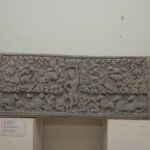
The Stone Anointing Ritual exhibits a striking thematic similarity to the famous Hindu myth of Krishna lifting Mount Govardhan to shelter the cow-herding children from the rain, thunder, and lightning sent by Indra (Figure 21). Both rituals share the central goal of securing protection from lightning strikes.
Additionally, a secondary belief associated with the anointment is that it promotes the children’s growth and ensures their holistic health. In light of this, San Sithon (2007–2008) concludes that while the Stone Anointing Ritual and the previously described Ploughing Ceremony (Chrot Preah Neangkol) are separate rites, they share a common underlying theme: the successful and vigorous flourishing growth—one focused on agricultural produce (rice) and the other focused on human beings (children).
1.5. Staking the Phum Deity Stems and Paddy in the Main House Pole Groove
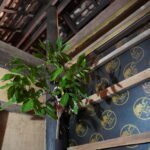
Immediately after the ceremony concludes, the villagers return to their respective homes, taking with them the remaining offering materials—specifically the rice/paddy and one of the Phum Deity Stems (the other stem having been staked at the rice field’s water inlet). Upon reaching home, the villagers secure the wild bean plant or the Phum Deity Stem adjacent to the rice/paddy or Rice Spirit (praloeng srov). This entire bundle is then placed into a groove (chrom) tied firmly to the Main House Pole (sasar kanlaong) (Figure 22). It is important to note that this groove tied to the main pole is explicitly not referred to as “Preah Tol,” unlike in Kuoy villages.
During this final act of staking or securing the items, participants utter a supplication requesting that the Phum Deity Stem and the rice/paddy protect the household from lightning strikes throughout the new year’s rainy season (Figure 23). This belief stems from the understanding that both items transitioned from ordinary objects into sacred artifacts by receiving power and energy from the Neak Ta during the ritual performance. As Mao Sitypunnavuth (2015) explains, the Main House Pole is conceptually linked to two Phum Deities: The Phum Deity of the land (Preah Phum-Dei Phteas) and the Phum Deity of the house (Preah Phum-Phteas). Consequently, the Phum Deity Stem and the Rice Spirit, now imbued with the Neak Ta‘s energy, are believed to emanate protection from the Main House Pole—the house’s crucial center—and permeate the entire household area. This ritual action reflects the profound human desire for peace and prosperity at home, especially regarding the avoidance of lightning danger.
This concept aligns with the custom of the Kuoy ethnic group, who stake the Rice Spirit onto the granary or secure it to the piled-up rice storage container (doak srov) in Veal Veang and Andas villages. Their intention is similar: to ensure that the Rice Spirit, imbued with the Neak Ta‘s energy and power, will guarantee the good growth of the seeds stored in the granary during the upcoming cultivation season.
To conclude the analysis, a close observation confirms that the ritual referred to by the villagers as the “Ploughing Ceremony” (Chrot Preah Neankol) is fundamentally concerned with the rice that has just begun to grow, anticipating a successful future harvest. Crucially, the main participants in the ritual are the young boys and girls, who are expected to grow up healthy, prosperous, and strong—just like the rice. This profound link highlights that humankind and rice are deeply intertwined in Khmer culture.

- Chamnar Chas Village
This text introduces the ritual practices in Chamnar Chas Village, which is situated close to Sambor Village. The inhabitants here also refer to their ritual as the “Ploughing Ceremony” (Chrot Preah Neangkol), or sometimes simply as “Farming” (Tveur Srae). When questioned further about the meaning of Chrot Preah Neangkol, the locals often concisely define it as “The New Year Transition” (Chlang Chhnam), thus frequently connecting the new agricultural season with the New Year. Despite the close geographic proximity between the two villages, the ritual practices in Chamnar Chas Village exhibit several interesting differences from the customs observed in Sambor Village.
Similar to Sambor Village, the Ploughing Ceremony in Chamnar Chas is led by a few elders known as the Chao Mueng. Generally, the ceremony begins with a Spirit Medium Invocation (Kech Banhchoin Roup) which must be performed to consult and determine an auspicious date and time.
- Auspicious Days: The chosen days are typically Tuesdays and Saturdays.
- Time Frame: This usually occurs during the waxing moon period of the month of Visak (Khmer: Péasakh), generally not extending beyond the fifth day of the waxing moon of Visak.
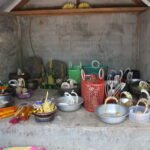
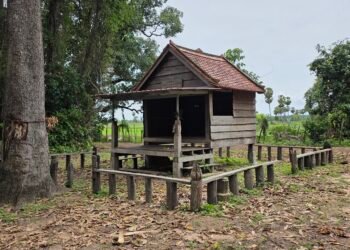
- Location: Traditionally, the ritual location invariably remains the shrine of the Neak Ta Chas Srok situated to the west of the village, consistent with the Neak Ta Enthronement Ceremony. As previously noted, the Neak Ta spirit embodies the earth and the stability required for successful cultivation and production (Figure 24).
The objects brought by the villagers to the Neak Ta shrine for the Ploughing Ceremony include a comprehensive array of items:
- Spiritual Items: Blessing threads, candles, and incense.
- Prepared Foods: Neali cakes (nom neali), ansorm cakes wrapped in ph’av leaves, and bananas.
- Seeds: Rice seeds (paddy), and various vegetable seeds such as corn, papaya, sponge gourd, winter melon, bottle gourd, cucumber, and pumpkin.
A crucial special ritual item, also utilized in Sambor Village, is the object representing a rice panicle, which locals call the “Rice Spirit” (Praloeng Srov) (Figure 25). The creation method for this representation is largely consistent with previously described villages: it consists of popped rice woven and staked onto a sliver of bamboo. The construction is meticulously done to ensure the tip is flexible and droops downward, mimicking a healthy, grain-heavy rice panicle. To enhance this curve, a small lump of rice flour dough is sometimes fixed to the bamboo splint’s tip. Alternatively, the pointed end of the rice panicle is bent and staked onto either the neali cake, the ansorm sleuk ph’av cake, or a banana to ensure the desired downward curve.
During the ritual, the Rice Spirit offerings are placed inside the Neak Ta shrine. Meanwhile, the rice seeds and various vegetable seeds are collected and grouped together in a basket or metal bowl positioned directly in front of the shrine (Figures 26–27). Near the Rice Spirit, a small woven container (taok)—a typical accessory of the spirit medium (roup snong)—is prepared for the subsequent Spirit Medium Invocation ritual (Ann Rasmey 2022).
In the late afternoon, the Chao Mueng’s group begins presenting offerings to the Neak Ta inside the shrine. This involves preparing areca nut and betel leaf bouquets, placing tributes in banana leaf cones (kantong), pouring liquor, and reciting ritual incantations. Essentially, this specific offering ritual closely resembles the Chrot Preah Neangkol ceremony in Sambor Village.
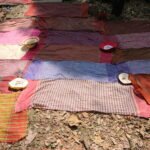
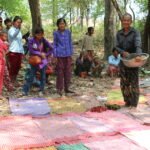
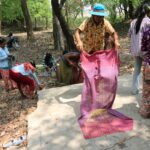
Concurrently, the villagers perform a symbolic act: they spread their personal Krama scarves end-to-end directly onto the ground on the plaza in front of the Neak Ta shrine, ritually designating each Krama as their individual rice field (Figure 28). For those whose rice fields are situated next to a pond (trapeang), a hat is placed near their spread Krama to represent the pond (Figure 29). This action clearly demonstrates the ritual capacity of ordinary human attire, such as the Krama and the hat, to be transformed conceptually into representations of a rice field and a pond. This parallels the symbolism of the rice panicles staked onto the neali cakes, which represent rice growing directly from the soil.
Following the offerings, the spirit medium (roup snong) is invited to possess the woven container (taok), where a burning candle has already been placed, thereby inviting the Neak Ta to preside over the ceremony. As stated, the Neak Ta is considered the embodiment of the earth and the stability essential for successful human agricultural yield; thus, the Neak Ta‘s presence is considered crucial and indispensable for any rite concerning agriculture. It is worth recalling that even though the Chrot Preah Neangkol in Sambor Village omits a spirit medium invocation, the Neak Ta nonetheless presides and grants authority and power, given that the ritual is conducted at the Neak Ta shrine with specific offerings.
Returning to the Spirit Medium Invocation in the Chrot Preah Neangkol of Chamnar Chas, it is noteworthy that no music is played. Music is generally reserved for the Leung Neak Ta ceremony, a “rising” ritual meant to provide joy and entertainment to the spirit, signified by the medium’s customary dance. Since the Chrot Preah Neangkol is not a “rising” ceremony, music is deemed unnecessary.
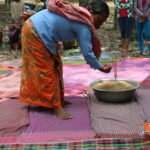
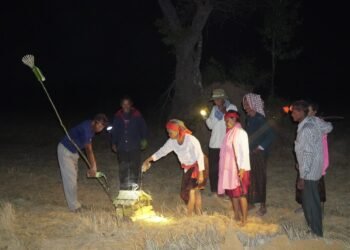
During the invocation, a female medium, whose face is covered by a Krama, begins to scoop paddy from the metal bowl and scatter it over the spread Krama scarves that symbolize the villagers’ rice fields (Figures 30–31). The surrounding villagers closely observe the amount of scattered paddy their Krama receives, as this quantity is believed to foretell their anticipated rice yield. Simultaneously, some villagers roll up the mats covering their Krama entirely to maximize the chance of receiving more paddy scattered by the Neak Ta medium. After the initial symbolic sowing, the Chao Mueng group continues to scatter the paddy until the entire contents of the metal bowl are exhausted and the rice grains are evenly spread across the surface of all the Krama scarves (Figure 32).
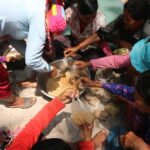
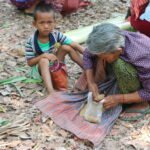
Following the completion of the sowing, those who spread their Krama and hats collect and wrap the rice seeds and other plant seeds that landed on their respective items (Figures 33–34).
- Donation to the State: A portion of the collected rice seed is returned as an offering to the Neak Ta, poured into a pile inside the shrine. This act is named the “Donation of Rice to the State,” suggesting that the people view the Neak Ta as the paramount authority figure of the entire community, thereby designating the spirit as the “State” (Radha).
- Placement at Home: Another portion of the rice seeds, along with the ritual “Rice Spirit” (Praloeng Srov) object, is taken home. These items are placed in the groove (chrom) of both the Main House Pole (Sasar Kanlaong) and the granary pole (Sasar Chongruk Srov), a custom shared with Sambor, Andas, Kon Kaek, and Veal Veang villages.
When placing these items, the villagers recite various traditional incantations to invoke the spirit. The use of thread to tie the Praloeng Srov to the actual rice panicle is common. An elderly woman from a nearby village recited this supplication:
“Come, Lady Prosperous, come from the dens and caves, from the mouths of the rivers, from Rompea Isle and the floating stone. Come flocking like the ropeak fruit, pile up like the fig fruit. Come, all of you together, enter our fields.”
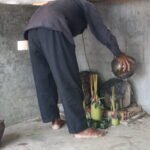
The Chrot Preah Neangkol ritual at the Neak Ta Chas Srok’s shrine in Chamnar Chas Village is not yet finished. Specifically, the Chao Mueng group brings water to pour and thoroughly soak the Neak Ta’s stone, ritually representing the desired heavy rainfall upon the village land, ensuring sufficient water for cultivation and farming (Figure 35). The final ritual act is the “Sending-Off” (Banhchuon), which involves the expulsion of savage ghosts or non-human savage beings from the village. These beings are believed to be responsible for causing sickness and disease in both humans and livestock. The offerings (sweets, snacks, and various foods) are sent off to the rice fields south of the Neak Ta shrine, as the rice field is the space designated by the people as the “outside of the village” domain for these jungle spirits to inhabit.
In conclusion, the Ploughing Ceremony in Chamnar Chas Village shares the same underlying meaning (prosperity for rice and humankind, and New Year transition) as the ceremony in Sambor Village. However, the ritual procedures themselves exhibit substantial differences, despite the close proximity of the two villages.



Bibliography
ចាប ពិន
១៩៦០, ព្រះរាជពិធីទ្វារទសមាស, ភាគ៣, ពុទ្ធសាសនបណ្ឌិត្យ, ភ្នំពេញ។
ម៉ៅ សិទ្ធិប៊ុណាវឌ្ឍន៍
២០១៥, ការកំណត់ និងប្រើប្រាស់លំហ, សារណាបញ្ចប់បរិញ្ញាបត្របុរាណវិទ្យា ជំនាន់ទី២៣ សាកលវិទ្យាល័យភូមិន្ទវិចិត្រសិល្បៈ, ភ្នំពេញ, ភ្នំពេញ។
សាន់ ស៊ីថុន
២០០៧, ជំនឿ និងពិធីទាក់ទងនឹងកសិកម្ម, សារណាបញ្ចប់បរិញ្ញាបត្របុរាណវិទ្យា ជំនាន់ទី
១៥ សាកលវិទ្យាល័យភូមិន្ទវិចិត្រសិល្បៈ, ភ្នំពេញ។
២០០៧-២០០៨, “ច្រត់ព្រះនង្គ័ល”, បណ្តាញពត៌មានក្នុងវប្បធម៌ខ្មែរ, ៣: ២២-២៤។
ហួន សាវង
២០២២, ទិដ្ឋភាពព្រះរាជពិធីច្រត់ព្រះនង្គ័លក្នុងសង្គមខ្មែរ, ផ្សាយអនឡាញដោយ AMS Khmer Civilization តាមរយៈតំណភ្ជាប់ https://khmercivilization.ams.com.kh/detail/22246
អាន រស្មី
២០២១-២០២២, “បើករដូវធ្វើស្រែមួយបែប”, បណ្តាញពត៌មានក្នុងវប្បធម៌ខ្មែរ, ១៧។
អាំង ជូលាន
២០០៨-២០០៩, “នំនាល”, បណ្តាញពត៌មានក្នុងវប្បធម៌ខ្មែរ, ៤: ២៣-២៤។
២០១២-២០១៣, “មាន់ឆ្កាង”, បណ្តាញពត៌មានក្នុងវប្បធម៌ខ្មែរ, ៨: ៣២-៣៦។
Discussion about this post