
 Khmer
Khmer
By: MANG Valy, AN Raksmey, SREY Sambunnarong
Supported By: UNESCO Participant Programme 2024-2025
The belief in arak spirits is ubiquitous throughout the villages and rural communities of Cambodia. This animistic belief system is fundamentally linked to the concept of illness etiology and subsequent treatment. Broadly observed, Cambodian belief structures are often predicated on a framework of cause and effect (causal-effect explanation).
Specifically, the arak belief serves as a traditional etiological model for human illness in the absence of modern, scientific medical explanations. For instance, when an individual within a household experiences symptoms such as headaches, abdominal pain, backaches, or blurred vision, the arak belief system provides the interpretative lens. The condition is often diagnosed as “transgression against the maternal arak” or “transgression against the paternal arak” (khos arak).
The “transgression” refers to disruptive behaviors or moral violations committed by the afflicted person, such as engaging in abusive arguments, verbal insults, or physical altercations. Once the underlying cause of the illness is thus identified, a method of resolution and treatment is sought. The ensuing therapeutic intervention typically involves a propitiatory ritual or offering (saen), which includes the presentation of rice wine, bananas, and other food items as offerings (samnaen). This practice illustrates the central thesis: the arak belief is intrinsically connected to the cause-and-effect explanation of illness and its subsequent management.
Returning to the term Arak, its etymology is traced to the Khmer word rakṣā, meaning protection, guardinahsip, or preservation. In the vicinity of the Sambor Prei Kuk archaeological site, local inhabitants employ various names for these spirits, most commonly referring to them as Kruo or Kruo Arak, which translates to Master or Arak Master. Furthermore, they are sometimes referred to by the term Tep Prāk, pronounced locally as Ta Prāk. Additional appellations include Kruo Deum Kamneut (Ancestral Master), Kruo Bāthyāy (Master/Teacher), Neak Kambāng (Hidden Person), Mchāsh Muni (Master of the Jewel/Muni), Chuor Chumboar (Ancestral Lineage), and Khmāoch Chhnuor (Stake/Boundary Ghost). Of special note, within this area, the term Mēmōt (Spirit Medium, often female) is not used, contrasting with other regions. The human group associated with the arak is designated as Disciples (Sĕs) or a Group of Disciples (Sĕs Kuṇa). In this context, Kru (Master) explicitly refers to the Arak spirit itself, which is inherently formless or invisible.
However, the spirit utilizes a human medium (rūb, literally ‘body’ or ‘form’) to serve as its vessel. This person acts as the spirit, speaking and communicating with the individual’s seeking consultation regarding the cause of their illness. It is during this possession ritual that the human medium, acting as the Kruo Arak, explains the etiology of the patient’s sickness. This possessed vessel is called the Rūb Ārak (Arak Medium/Vessel). The music performed to induce the trance and possession is known as Phlēng Ārak (Arak Music). A close female attendant, known as the Snoăm (Consort or Ritual Assistant), plays a vital role in managing the ritual paraphernalia (betel quid, wine, offerings) and serving as the interlocutor, translating or communicating in the arak’s language during the possession ceremony.
The possession ritual (banhchoăn rūb) occurs in three distinct ceremonial seasons:
- Diagnostic Ritual (Illness Consultation): When an arak disciple is sick, they must meet the Snoăm and the Rūb Ārak to invoke and possess the Kru Arak to ascertain the cause of the illness.
- Annual Feast (Lieng Ārak): Annually in the month of Meakh (roughly February), all disciples (Sĕs Kuṇa) belonging to the same arak lineage gather at the Rūb Ārak’s home to perform the Arak Feast or Feeding the Arak (Lieng Ārak), a yearly propitiatory ritual.
- Succession Ritual (Lieng Rŏk Rūb): A special Lieng Ārak ritual is organized to find a new medium to replace a deceased Rūb Ārak. This is termed Feast to Find a Medium (Lieng Rŏk Rūb), reflecting the disciples’ profound concern over the necessity of having a human vessel through which the arak can be possessed, speak, and interact with the community.
The initial formation of the relationship between the Disciple and the Arak Master begins when a baby reaches an age suitable for being carried and moving about (typically as a toddler). The parents take the child to the Rūb Ārak (Arak Medium) for a ritual of blowing and chanting (stŏs phlum) over the child’s fontanelle (top of the head). This act is intended to confer strength, robustness, and complete health, thereby protecting the child from various diseases and ailments.
From this moment onward, the child is bound by a sense of obligation and protection (sândâs) to the arak—becoming a disciple in the arak lineage. Subsequently, if this individual suffers from an unexplained illness, or if conventional medicine fails to bring improvement, the Kru Ārak must be consulted. The individual returns to the Rūb Ārak to receive the same customary blowing and chanting ritual as performed in infancy.
In severe cases, a ritual to retrieve the soul of the afflicted person may be performed. This serves as a fundamental health insurance and therapeutic guarantee for the disciple. The underlying explanation is that some souls are captured by a local territorial spirit (neak ta) due to an act of verbal abuse or insult—termed “khŏs moăt” (offending by mouth)—or due to a sudden fright that causes the soul to flee (“phĭt phĭy lôs prôlŭng” – scared and lost the soul). The Rūb Ārak must then intervene to retrieve the soul from the spirit mound or sacred grove (prey neak ta). This involves preparing a soul feast offering, along with the patient’s clothing (shirt, trousers, necklace). The retrieved items are then brought back to the waiting patient (cf. Thompson 2004).
The arak spirits are typically divided into two lineages: the Maternal Arak and the Paternal Arak.
- The first-born child is traditionally presented to the Paternal Arak for the blowing and chanting ritual.
- Subsequent children are then alternately assigned, so the second child goes to the Maternal Arak, the third returns to the Paternal Arak, and so on.
Occasionally, it is observed that a sick baby fails to recover even after receiving the ritual from the designated Paternal Arak Master. This is explained by the fact that the Maternal Arak Master also holds a duty to protect the child. In such instances, the child must either receive a supplemental blowing and chanting ritual from the Maternal Arak Master or be permanently assigned as a disciple under the Maternal Arak’s care.
The explanation provided is that the Maternal Arak Master is demanding the child. Consequently, the child’s illness persists despite the Paternal Arak’s intervention. Therefore, the child must be transferred to the Maternal Arak Master for treatment. This situation exemplifies the concept of Arak Masters competing for disciples. A Master with a large following gain a stronger reputation, which in turn makes the collective funding of the annual Lieng Arak (Arak Feast) ritual easier, due to the larger contribution base.
- The Arak Lexicon (Săp Ārak)
The term Săp Ārak refers to the specific ritual language used to communicate with the Rūb Ārak (Arak Medium) during the ceremony. This language is commonly known as “Ghost Language” (Phéasā Khmāoch) or Arak Lexicon (Săp Ārak) (cf. Saveros Pov et Ang Chouléan 1987-90). Locally, in the Sambor Prei Kuk area, this is referred to as the “Language of the Hidden One” (Phéasā Neak Kambāng), exemplified by terms like “Péak Neak Kambāng” (The Hidden One’s Word), “Phéasā Kruo” (Master’s Language), or “Péak Lôk Kru” (The Venerable Master’s Word).
The Săp Ārak contains a rich vocabulary that can be classified into distinct groups:
- Royal/Regal Vocabulary (Rājsăp): A significant portion of the Săp Ārak consists of words derived from the royal lexicon (Rājsăp), elevating the status of the spirit. Examples include:
- Sāoĕy (សោយ) – To eat/consume (Royal term)
- Prĕah Ōs (ព្រះឱស) – Mouth/Speech (Royal term)
- Prĕah Pôsr (ព្រះពស្ត្រ) – Clothing (Royal term)
- Prĕah Khan (ព្រះខ័ន) – Sword (Royal term)
- Thvāy (ថ្វាយ) – To offer/present (Royal term)
- Snoăm (ស្នំ) – Consort/Ritual Assistant
- Figurative/Metaphorical Descriptions of Objects: Other words are metaphorical descriptions used to refer to common objects:
- Trâmōl (ត្រមោល) – Coconut (literally: The shady/dark fruit)
- Rômœ̆l (រំអិល) – Beeswax (literally: The smooth/slippery substance)
- Dâmbông (ដំបង) – Incense stick (literally: The club/stick)
- Sâm yong (សំយុង) – Betel leaves (literally: The hanging item)
- Srôum (ស្រោម) – Shirt/Jacket (literally: The sheath/casing)
- Sāhāu (សាហាវ) – Rice wine (literally: The fierce/strong substance)
- Kântôn Bāk Kā (កន្ទន់បាក់ក) – Banana (literally: The broken-neck banana bunch)
- Metaphorical Noun Phrases (Metonymy): A third group employs terms with entirely figurative or metonymic meanings:
- Chāp or Koun Chāp (ចាប ឬ កូនចាប) – The Patient (literally: Bird or baby bird)
- Rôngéav (រងាវ) – To Sing (literally: To chirp/make a noise)
- Nôkôr (នគរ) – The Village (literally: The kingdom/city)
- Sĕs knŏng Nôkôr (សិស្សក្នុងនគរ) – Disciples within the Village
- Sĕs Tônlé Vêng (សិស្សទន្លេវែង) – Disciples from outside the Village (literally: Disciples from the long river)
- Kngôk Mās (ក្ងោកមាស) – The Buddhist Monk (literally: Golden Peacock)
The following table presents some of the specific Săp Ārak (Arak Lexicon) terms used in the region around the Sambor Prei Kuk temples:
- Koun Srŏk Koun Srê : People living in the village/villagers
- Kâmpâong : Money
- Kān : Person, plant, or animal protected or possessed by the spirit
- Kântœ̆nh : Pig
- Trâmōl/Krâmōl : Coconut fruit
- Kngôk Mās : Buddhist Monk
- Khnhăl : Angry
- Khsêr Srâlāy (Arak Lineage) : Group of people sharing the same Arak Master
- Khŏs (Transgression) : Action, deed, or word committed wrongly that leads to illness
- Khmāoch Prei (Forest Spirit) : Non-human entity in the forest, also called Krup Prei or Neak Prei
- Kĭt Ku (Ritual Observance) : To recognize, not forget, or abandon one’s Arak Master, regularly bringing offerings for supplication when sick or attending the annual Arak Feast
- Koăs Rôbœ̆k : Illness is completely cured, opposite of koăs mĭn rôbœ̆k – not cured
- Chāp : The patient
- Chângkrâong/Kânhchrâng : Ox (Cattle)
- Chrāk : Enter Medium / Possess (To enter the medium’s body)
- Choăn : Enter Medium / Possess (To enter the medium’s body
- Chhmōl : Male Disciple
- Nhĭ : Female Disciple
- Thārŏng : Husband
- Thvāy : Give / Offer (To give/present)
- Tŭm : Arak comes to reside in the medium, or the person becomes the medium
- Thyéan : Enter Medium / Possess
- Nôkôr : Village
- Dâmbông : Incense Stick (Incense)
- Bâksei : Chicken
- Bânhchuon : Offer / Send Off Offering (To offer the sâmnaen or send off the pê offering)
- Bāy-Sâmlâ Sés : Rice and curry cooked without tasting for the offering/ritual
- Péary : Ritual Music
- Pôpĭ Rūb : Wife
- Prĕah Khan : Sword
- Pastra : Cloth/skirt
- Prĕah Ōs : To Speak
- Sraong : an illness/disease
- Rôngéav : To Sing
- Rômœ̆l : Beeswax
- Rômphāy : Scarf / Kerchief
- Rômbâl/Mé Rômbâl : the word réal (to spread), referring to an epidemic like cholera causing widespread sickness and death. Sometimes called Preăy Rômbâl – Epidemic Demon
- Sâmbâk : Basket / Container
- Sĕh : Tiger
- Sāhāu /Ākār Sāhāu : Rice Wine / Alcohol
- Sâm yong : Betel Leaf
- Suorkât : To Die / Deceased
- Sbāy : Krama (Khmer Scarf)
- Sūphī : Buffalo
- Srŏk Krâ : A condition where many people in the village are sick
- Snoăm : Ritual Attendant / Consort (The Arak medium’s close assistant, responsible for preparing the ritual items, betel quid/cigarettes for the medium, and capable of speaking the Arak Master’s language)
- Sākhā : Forest Spirit / Arak (Non-human entity in the forest, often cited as the cause of human illness)
- Sângkhœ̆k : Square Offering (A square receptacle made from banana sheaths used to hold the pê offering, which is sent far outside the village)
- Āpéat : Sick / Ill
- Ārœ̆s : Infant Ailment / Seizure (A type of infant ailment causing crying or twitching during sleep. Parents usually make a necklace or bracelet pendant containing medicinal herbs (like tréang and black mrĕh prâv), which the child wears for protection. The child often habitually holds this medicine packet in their mouth)
- 2. About the Phlēng Ārak (Arak Music)
Based on observations in the Sambor Prei Kuk region, the Phlēng Ārak (Arak Music) ensemble traditionally features the following instruments: two or four Skor Ārak (Arak Drums), one Pĕi Ār (cylindrical oboe, sometimes called Pĕi Ōr) or Pĕi Pāt (a type of oboe), one Trŏ Sāo (two-string vertical fiddle). The vocalists frequently double as the drummers. Currently, the Pĕi (oboe) is often absent from some Phlēng Ārak ensembles. This is attributed to the fact that musicians skilled in playing this instrument are often elderly, some have passed away, and there are few young people learning to continue the tradition. The Drum holds exceptional importance within the Phlēng Ārak ensemble. Its sound must be loud and stirring (phŭh kânhchrôul) to incite the Rūb Ārak (medium) to become emotionally moved, tremble intensely in their limbs, or to joyfully dance, fulfilling the ritual requirements for possession. It is common to find old, broken, and unplayable Chāpĕi (long-necked lute) instruments left neglected in the homes of the Rūb Ārak, which were previously used in the Phlēng Ārak ensemble.
The Phlēng Ārak ensemble performs a significant number of songs during the Liĕng Ārak (Arak Feast) ritual. The initial piece played is called “Invite the Master” (Ānchœ̆nh Kruo). The Master (Kruo) referred to here is Preah Pĭsṇukār, the divine architect and patron deity of the arts. The offering set for this music master is called the “Preah Pĭsṇukā Offering” or Chom Bŏun, which is placed in the center of the musical ensemble. Following this initial piece, various other songs are performed sequentially, according to the specific repertoire and preference of each Kruo Ārak. The Rūb Ārak (medium) and the Snoăm Ārak (ritual attendant) must memorize the names of the tunes required to properly invoke the Master to possess the medium and dance. As stated previously, the Kruo Ārak spirit is formless and intangible; the dancing is performed by the human medium, the Rūb Ārak.
It is firmly believed that if the music is played incorrectly or the lyrics are not sung accurately, the Kruo Ārak will not enter the human medium. During the performance, the sound of the drums is often loud and resonant, making the lyrics of the songs difficult to distinguish clearly. The performance usually begins with a slower, more deliberate rhythm. After a short while, the drummers begin to beat the drums faster and louder to further incite the medium to tremble quickly and feel the desire to dance. The various Arak songs, briefly summarized, include titles such as: Nôkôr Réach, Srôum Néay, Phnum Srŭŏch, Sâsôr Kânlâong, Dâmrei, Âk, Tā Thāu, Srôkŭm Srâkéal, Srei Khmâu, Prĕah Băt, Sŭriyā, Sārikā, Chumtéav Māu, Mlŭp Dông, Preyi Âkœ̆t, Moăn Rôngéav, Kâmpâor, Ŭŏk, Ŏm Tŭk, Bĕh Phkā (Figure 1-2).
The Lieng Ārak (Arak Feast) concludes with the performance of the Picking Flowers (Bĕh Phkā) tune, followed by the Ritual Canopy Removal (Sā Pĭtān). During this final act, the musicians dance and sing underneath the pĭtān, which is a white piece of cloth tied up like a canopy above the chom kru (Master’s altar). While dancing, they touch and pull down the canopy and the surrounding cloth railings, symbolizing the dismantling of the temporary Arak feasting hall. This act also contains a symbolic wish: that the Phlēng Ārak (Arak music) should only be heard once at this annual feast. This implies that all disciples will remain in good health, as illness would necessitate the offering of music for treatment outside the annual ritual. Following the dismantling, the Sending Off the Offering is performed. The offering is taken and discarded far away from the feasting venue, symbolizing a location outside the village boundaries. This act is accompanied by a banishing chant, such as:
“Get out of the village (nôkôr), go along the long river (tônlé vêng). Go far away from the local settlement. The near ones take the cooked rice, the far ones take the paddy (uncooked rice). Go home and never return!”
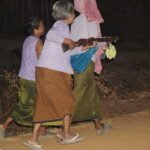
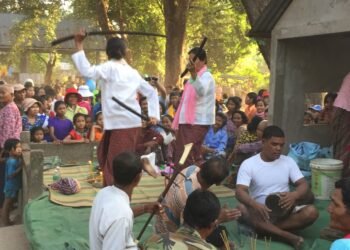
During this banishment ritual, a man acts out a dramatic gesture, holding a sword as a display of force, making gestures of chasing and cutting the person carrying the pê offering away. The carrier must flee quickly and frantically, never daring to look back. Locals explain that the Bânhchoăn Pê is intended to drive away the malignant spirits (preăy) and the Epidemic Demons (Mé Rômbâl) that cause contagious diseases like cholera, which kill humans and cattle in the village, making them leave forever with the offering. Separate from the main feast repertoire, there is another type of music played for a ritual combat between the Arak Master (the medium) and the Arak Disciples. This music is called Javanese Music. The instruments used for this Javanese ensemble include: one pair of Javanese Drums (Skor Chvéa or Skor Vêng – long drum, one Hoe/Pickaxe Blade (Phlê Châb Kăp) struck to produce a sound, substituting for the traditional gong. The combat itself is not a physical fight. Instead, it consists of choreographed movements of hands and feet, performing martial arts stances, or simply touching hands, symbolizing a contest of win and loss. It is always observed that the Disciple loses to the Rūb Ārak (Master), subsequently kneeling and bowing in admission of defeat. The Rūb Ārak then presents the disciple with rice wine or a banana as a reward. This ritual combat is typically performed twice: once in the early evening and again late at night, around midnight.
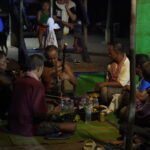
- Naming the Kruo Ārak Spirits
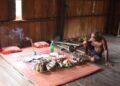
Each Rūb Ārak (Arak Medium) is associated with multiple Kruo Ārak (Arak Masters) whose names are diverse and numerous. Based on the accounts provided by the Snoăm (Ritual Attendants) and the group of disciples, the names of the Kruo Ārak include: Tā Chĕy, Srei Khmâu, Sâ Sʾāat, Tŏn Lpăo, Sdăch Stâeng, Sdăch Prĕay, Pĕch Vāyu, Mœ̆n Kêv, Ântĭt Sâng, Tŏch Stœ̆ng, Dâmbông Dâek, Tā Māu Kbăl Tŭk, Tā Sŏk Prey Leu, Tā Kông, Ântông, Srei Snguŏn, Pôk Sânlâp, Châek Rôhaeng, Tŭmlāy Nôkôr, Pĕch Vĕy, Mœ̆n Māu, Vĕy Vôngsā, Kâmhaeng Chhœ̆ Téal, Kâmhaeng Thmâ, Kâmhaeng Thnung, Kâmhaeng Pôl Rôsăt, Sâmpông Sâk Thum, Réamânt, Kânghā Dâek, Krâpŭm Chhŭk, Tônsāy, Tā Âek, Kôl Bŏtr, Ktĭp Dông, Tā Pĕch, Kântŭp Tbăl Kĕn, Kông Dâmbông, Bârâmĕsŭr, Tĕi Sângraeng, Ângk Thôrânĕi, Bâllâng Pĕch, Rômpăt Mās, Pŏu Lbaeng, Neak Srâtŭm, Sdăch Srâlāy, Krâʼŏb, Môhā Eăsĕy, Tā Sôm, Tā Svā, Kruo Sândâs (Figure 3-4).
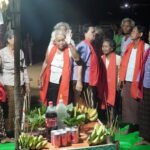
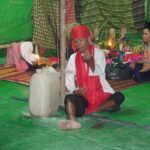
4. About the Lieng Ārak (Arak Feast)
The term “Lieng Ārak” is a compound word derived from the word Lieng, which is believed to be of Siamese origin and translates to the Khmer concept of gathering for food and drink (like Sĭ Liĕng or Chŭp Liĕng – to feast or party). Annually, during the months of Meak (February) and Chêtr (March), the disciples —both those residing in the village and those who have moved away for work—gather to organize the Arak Master’s Feast. This gathering serves as an important occasion for the disciples to show respect, express gratitude to the Master, and receive the collective ritual blowing and chanting (stŏs phlum) for healing.
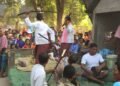
The ritual features the performance of Phlēng Ārak (Arak Music) that lasts the entire night, aiming to possess the Arak medium to dance for joy and to perform the healing stŏs phlum for the disciples. The disciples contribute money, rice wine, bananas, canned sodas, ânsâm (rice cakes), fish, meat, vegetables, and rice. These ingredients are used to prepare food for the Arak musicians and all participants. Even disciples who live or work far away often send money to support the feast’s expenses, which cover the cost of food, construction of the ritual pavilion, paying the Arak musicians, electricity, and presenting gifts to the medium. This act is referred to as Rāp Rŏk (To Recognize/Acknowledge) or Kĭt Ku (To Remember/Care For). It signifies that they have not abandoned their Arak Master, as the Master serves as their crucial support system: when ill, they rely on the medium’s possession ritual to inquire about the cause of the sickness and seek treatment.
The Feast Structure:
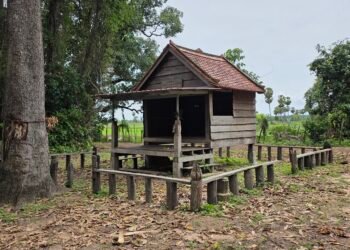
- A ritual pavilion is constructed in the front yard of the medium’s house for the gathering.
- The ceremony begins in the early evening, a time when cattle are assumed to have returned to their pens, and the music commences.
- The Snoăm (Ritual Attendant) is responsible for preparing a bundle of clothes for the medium to change into, as well as preparing the rice wine, cigarettes, and betel quid to present to the medium once the Kruo Ārak possesses the vessel.
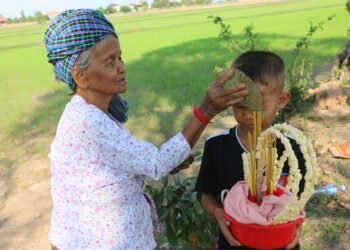
- The medium holds a small basket (tâok) in both hands to induce possession. A candle is lit on the tâok to illuminate a mound of rice (sĭen ângkâr).
- Upon the spirit’s possession, the medium takes the flame from the candle into their mouth three times. This is called Ôp Moăt, also known locally as Rôul Moăt or Sĭ Phlœ̆ng.
- If the Master is male, cigarettes or rice wine are offered; if female, betel quid is presented. Female Masters wear a tunic (āv bâmpông) and a silk skirt (sâmpôt hôul), while male Masters wear a knotted lower garment (slĭek kbĭn).
- The medium’s voice changes from its normal pitch to a smaller, higher-pitched voice.
- Songs are played according to the taste of the Arak Master who has possessed the medium to dance.
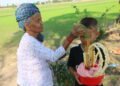
- During the ritual, the disciples bow their heads near the medium to receive the ritual blowing and chanting with betel quid juice over their head, abdomen, back, and limbs to expel the illness from the body.
- Each disciple shows a happy, refreshed, and joyful expression after receiving the stŏs phlum.
- The feast lasts all night, sometimes concluding only at midnight or dawn.
- Some possessed mediums display angry, aggressive dance movements, grabbing and eating bananas and cakes in an awkward or abnormal manner. This behavior is explained as being caused by a female non-human spirit residing in the forest, which causes sickness because humans have violated taboos (khŏs moăt khŏs kā) or used foul language near the forest. This is the source used to explain the etiology of illness.
- It is further explained that this non-human entity is a Sākhā of the Arak Master. This Sākhā also has its own human medium and can speak with people to explain the specific reasons for their illness.
In cases where the disciples lack the financial capacity to organize the full Lieng Ārak feast due to a small number of members and difficulty covering the various expenses, they perform a simpler ritual.
They only gather at the medium’s house to perform betel quid consecration and install new chom (altar decorations/offerings), replacing the old ones placed on the Arak Master’s shelf. This rite is called Rĭĕp Kruo (Arranging the Master) or Dāoŭt Chom (Installing the Chom). Another regular time for disciples to replace the old chom is every year during the Pchum Ben festival. On this day, a possession ritual is performed to inform the Master of the replacement and receive the stŏs phlum. The Rĭĕp Kruo—Dāoŭt Chom ritual takes only one morning to complete. It involves no Phlēng Ārak (music), no temporary pavilion, and no extensive feasting. This is in stark contrast to the Liĕng Ārak feast, which takes nearly the entire night, requires music, a pavilion, and elaborate offerings. For the Rĭĕp Kru, the initial preparations include one large consecrated betel quid and four small consecrated betel quads, along with four chom. Some Masters require the pê offering, while others do not. The medium is possessed without the need for accompanying music. After the Arak Master possesses the medium, the gathered disciples describe the various hardships they are facing and explain the reasons and problems that prevented them from holding the full Lieng Ārak feast. Following this, the disciples describe the specific illnesses and ailments they suffer from and request the Master’s help for healing (Reference to Figure 5-6).
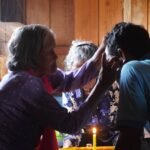
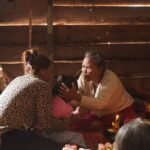
The Lieng Ārak (Arak Feast) is a comprehensive ceremony consisting of several key ritual actions performed throughout the night and extending into the following days.
- The Ritual Combat (Kech Prâdăl)
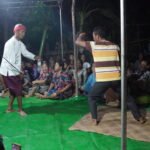
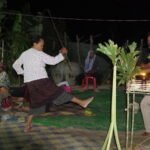
In some Kruo Ārak feasting halls, a unique type of music, the Javanese Drum Music (Phlēng Skor Chvéa), is played. This music accompanies a ritual combat (prâdăl) between the Arak Medium and the male disciples, intended to amuse and please the Master. The combat sometimes involves the display of martial arts postures (kbăch kun) with hands and feet facing one another, mimicking a real fight. However, there is no actual hitting, kicking, or physical violence. The combat is symbolic, where a simple touch of hands signifies winning or losing. At the end of the bout, the medium offers rice wine or a banana to the disciple who participated in the combat. It is noted that some Masters engage in this combat while others do not; hence, some Arak feasting halls feature the Skor Chvéa performance and combat ritual, while others omit it (Figures 7-8).
2. The Ritual Blowing and Chanting (Stŏs Phlum)
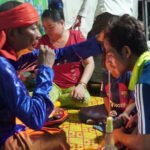
It is observed that the participants in the Lieng Ārak are predominantly women, both young and old, outnumbering men. Besides the disciples, other Arak mediums from the same village attend to dance and entertain, thereby reciprocating a social obligation. When it is the turn of one of their fellow mediums to host a feast, they will all go to dance at that venue. The participating disciples approach the Master to receive the ritual blowing and chanting (stŏs phlum) and the application of beeswax to various parts of the body, such as the forehead, neck, abdomen, and limbs. This healing act is the primary objective for the disciples attending the feast.
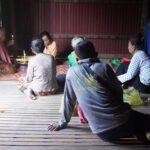
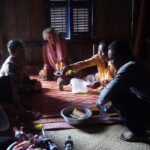
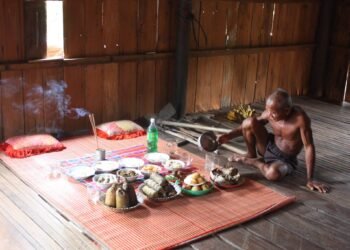
Customarily, when a disciple falls ill and believes the cause to be a transgression against the Master of Obligation (khŏs kruo sândâs), they must prepare a pair of consecrated betel quids (slā thŏar), a ritual known as Rĭĕp Sândâs (Arranging the Obligation). This offering is placed at the head of the sleeping area, along with rice wine, bananas, and incense, to pray for the recovery from the illness (Figures 9-11).
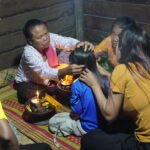

3. The Ritual Elevating of the Altar Shelf (Săen Lœ̆k Hœ̆ng)
During the night of the Arak Feast, a ritual called Săen Lœ̆k Hœ̆ng (Offering and Raising the Altar Shelf) is performed three times: once between 8 and 9 PM, once at midnight, and a final time just before dawn, marking the end of the ceremony. The Hœ̆ng refers to the wooden shelf/altar where the consecrated betel quid and the Master’s chom are placed inside the house. It is customarily believed that every three years, this shelf must be brought down into the feasting hall for the Săen Lœ̆k Hœ̆ng ceremony.
The term Lœ̆k (To Raise/Lift) here is meant in the sense of exalting the prestige and power of the Arak Master, enabling the Master to powerfully and effectively heal the disciples’ illnesses, consistent with the Master’s blessing:
“Tie one to be firm, tie ten to remain. Hold one to be secure, hold ten to endure. Protect the children and disciples equally. May the enemy be coming from the front pass by, may the enemy be coming from the back retreat far away.”
This blessing is given while pouring rice wine at the four legs of the altar shelf and tying threads onto the shelf. The disciples then sprinkle powder onto the shelf, spray water and perfume, and complete the thread-tying ritual. Afterward, the shelf is paraded back upstairs and placed back in its original room (Figures 12-13).
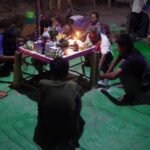
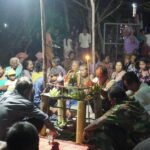
4. The Banishment Ritual (Bânhchuon)
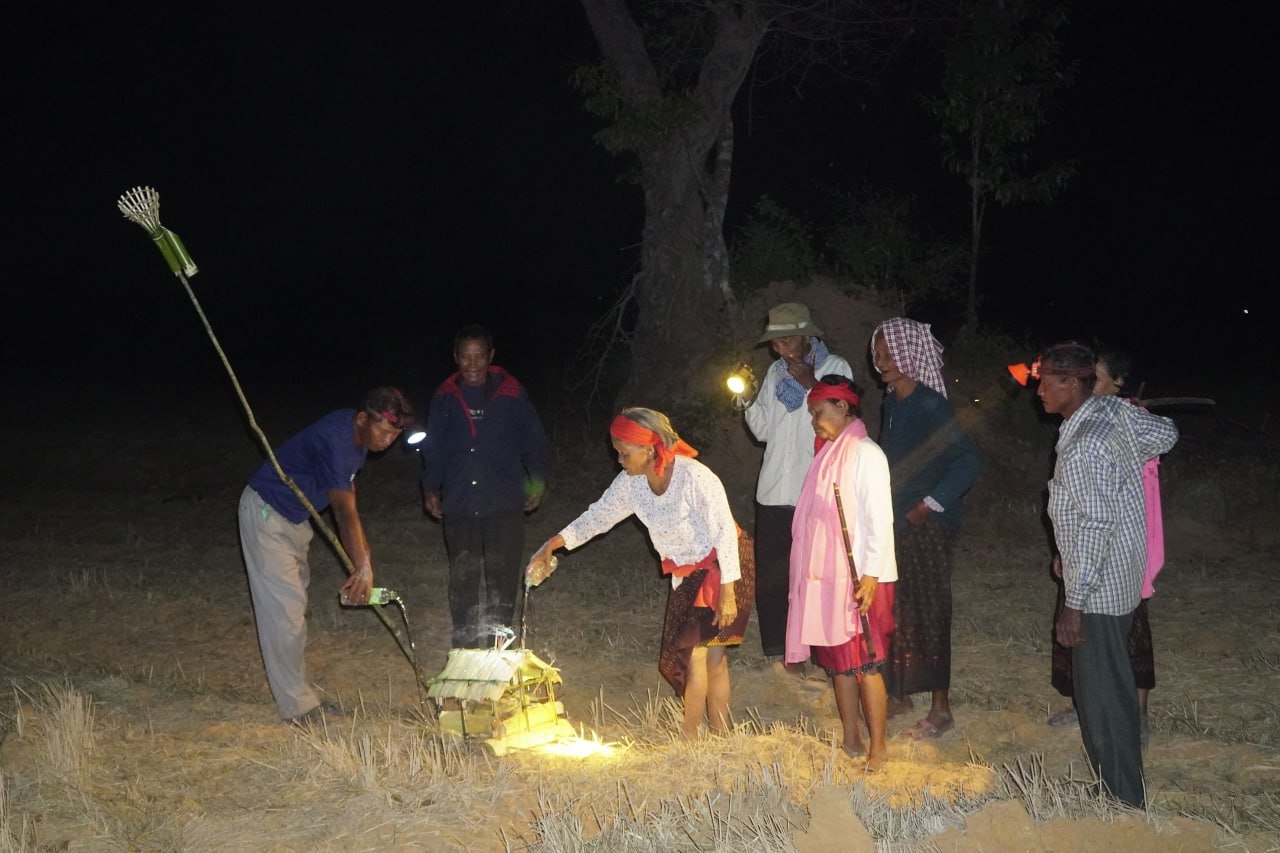
As previously mentioned, Bânhchuon is a verb derived from Chuon (To Send/Deliver). In this ritual, the pê offering, containing various foods (curries, rice, cakes, delicacies), is carried far away to be presented to the non-human entities that cause sickness and epidemics (rômbâl) in the village, which are referred to as Mé Rômbâl (Epidemic Mother) or Preăy Rômbâl (Epidemic Demon).
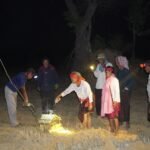
The ritual is performed near the end of the Lieng Ārak feast, where the offering is placed in a designated spot, symbolizing a location outside the human settlement. The rationale is that by placing the offering far away, the epidemic illnesses will also leave the village. The ritual is accompanied by a chant:
“Get out of the village, go along the long river (tônlé vêng). Go far away from the local settlement. The near ones take the cooked rice, the far ones take the paddy (uncooked rice). Go home and never return!”
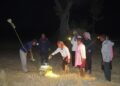
During this banishment, one musician acts as the Chaser/Cutter, holding a sword, performing martial arts stances, and dramatically chasing and cutting the person carrying the pê offering to the disposal site. Sometimes, the chaser uses a wooden gun. These actions are intended to frighten and drive away the disease-causing spirits so they dare not remain in the human settlement (Figures 14-16).
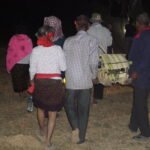
5. The Soul Retrieval for the Medium (Yôk Praloeng Āoy Rūb)
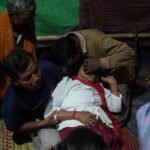
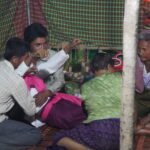
It is understood that the medium who was possessed by the Arak Master all night until dawn may have lost some of their soul or that the soul is not securely in the body due to exhaustion or fatigue. Therefore, the disciples must perform a soul retrieval ritual at the end of the feast to restore the medium’s full and complete health. The procedure is as follows: The medium holds the tâok (basket) with both hands and spins it left and right. The medium then releases the tâok and takes a tray (téab) offered by a disciple, replacing the basket. The medium then lies motionless as if unconscious, leaning on a disciple who supports them from behind. The Snoăm and the disciples take threads and tie the medium’s two hands while they are still motionless and unaware. During the hand-tying, they chant:
“Tie the hands to be secure, hold the tâok to endure. Hold one to be secure, hold ten to endure.”
The word Kān (Hold/Grasp) here implies protecting the disciples within the Master’s grasp so they remain safe and free from illness. After the hands are tied, a male disciple shouts loudly into the medium’s ear three times to make the medium regain consciousness. The medium starts and wakes up. They then take the tâok to make the Arak Master leave the body, and finally wave their hand to extinguish the candle flame on the tâok. The ritual of retrieving the soul for the medium is then complete (Figures 17-18).
6. The Ritual Canopy Removal (Kech Sā Pĭtān)
In this final act, two musicians climb up to dance and sing beneath the cloth canopy (pĭtān) that was draped over the Master’s altar shelf (hœ̆ng), and pull down and tear apart the canopy. The “flowers” to be picked (bĕh phkā) are the betel leaves, yom-yom leaves (slœ̆k pôul yum), and areca nut slices that were tied loosely and symbolized as flowers on the cloth canopy.
Before the dancing and “flower picking” begin, the musicians perform an offering to the “flower pick” beneath the canopy to ensure the picking goes smoothly and the Lieng Ārak feast concludes peacefully. After the offering, the musicians play the Picking Flowers tune, and the two musicians who performed the offering stand up to dance and sing. While dancing, they reach out to pick the “flowers” and tear down the canopy, which they then wrap around their necks. They then pull down the remaining cloth railings, chanting:
“Having picked the flowers, we remove the canopy… having picked the flowers, we remove the railings…”
After the removal, a woman, acting as the owner of the canopy shawl, engages in a dialogue with the musicians:
Musician: Whose shawl is this, left abandoned by the well?
Old Woman (Yéay): It is mine.
Musician: Why did you forget it by the well?
Old Woman: I was flirting there and forgot it.
Musician: If it is truly yours, how many cubits (hăt) long is it?
Old Woman: 19 cubits in total (approximately 9).
Musician: (The musician then proceeds to measure the cloth with his hands, counting from 1 up to 19 cubits).
Old Woman: Be careful not to shortchange me.
Musician: It’s not short, your property is complete—19 cubits is correct. What will you offer in exchange (lôs) for it?
Old Woman: One bottle of rice wine.
Musician: That is a great prize indeed!
Upon completing the dialogue, the musician takes the shawl and counts it while violently swinging it up and down, counting from 1 to 19, making a sound as if throwing it out of the feasting hall, saying:
“May all misfortune disappear! It is enough to hear the music only once a year!”
After the chant, he hands the shawl to the old woman, who offered the wine in exchange, stating that the nine clustered souls are complete and whole. The old woman gives the wine in exchange for the shawl. The “flower picking” dance concludes here (Figures 19-20).

7. The Post-Feast Consecration (Trăh)
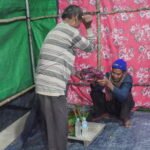
The ritual period lasts three days from the day of the feast to the final Consecration (Trăh or Trăh Kruo – Master’s Consecration). On the morning of the final day, around 5 AM, the elderly disciples gather at the medium’s house to perform the Master’s Consecration. It is also on this morning that the temporary Arak feasting hall is dismantled (sā rông). The items used for the consecration are the leftover offerings from the feast: bananas, ânsâm, sodas, rice wine, and money. The tray (téab) used in the soul retrieval ritual the previous night is also opened on this day, containing bananas, ânsâm, and some money. All the leftover items from the feast are distributed among the disciples at this time.
A possession ritual is performed to allow the Master to communicate, discuss the recently concluded feast, and bless the disciples with good health, ensuring they suffer no further illness. A square offering receptacle (sângkhœ̆k) is prepared with bananas, ânsâm, sodas, and consecrated betel quid. Rice wine is poured, and rice is scattered over the sângkhœ̆k while chanting:
“It is enough to hear the music only once a year. Do not cause further disturbances. They have been sent home; may the people of the village (nôkôr) be well and happy.”
Once the Trăh Kruo ritual is complete, the sângkhœ̆k is discarded at an anthill (dâmbuk) or near a large tree behind the house (Figures 21-22).
Bibliography
ស្រី សមប៊ុនណារ៉ុង
២០២៣, កិច្ចដោតជម ឬរៀបគ្រូនៅភូមិសំបូរ, ផ្សាយអនឡាញដោយ AMS
Khmer Civilization តាមរយៈតំណភ្ជាប់ https://khmercivilization.ams.com.kh/detail/26843
២០២៤, លៀងអារក្សនៅភូមិសំបូរ, ផ្សាយអនឡាយដោយ AMS Khmer Civilization តាមរយៈ
តំណភ្ជាប់ https://khmercivilization.ams.com.kh/detail/29792
អាន រស្មី
២០១១, លៀងអារក្សនៅភូមិសំបូរ, សារណាបញ្ចប់បរិញ្ញាបត្របុរាណវិទ្យា ជំនាន់ទី១៩
សាកលវិទ្យាល័យភូមិន្ទវិចិត្រសិល្បៈ, ភ្នំពេញ។
អាំង ជូលាន
២០០០, មនុស្ស និងដី, រៃយំ, ភ្នំពេញ។
២០០៥-២០០៦, “គ្រូកំណើត”, បណ្តាញពត៌មានក្នុងវប្បធម៌ខ្មែរ, ១: ៤៣-៤៤។
Ang Chouléan
- Les être surnaturels dans la religion Populaire khmère, Centre de Documentation et
de Recherche sur la Civilisation Khmère, Paris.
Saveros, P. & Ang Chouléan
1987-90. “Vocabulaire Khmer relatif au surnaturel”, Seksa Khmer.10-13, Paris:
CEDORECK, p.59-129.
Thompson, A.
- Calling the Souls: A Cambodian ritual text, Reyum, Phnom Penh.
Discussion about this post